When the spreadsheet stops being worth it
Spreadsheets are flexible, familiar, and often the right tool. This guide helps you spot when maintaining one starts to get in the way of coaching.
The short version
- Spreadsheets make it easy to design a block. Delivery, logging, and review still happen elsewhere.
- Pay attention when routine edits take long enough that you begin postponing them.
- Most coaches hit the threshold between six and fifteen athletes, earlier if the roster is varied.
- Choose software that still lets you see the whole block at once.
Why the spreadsheet worked in the first place
Spreadsheets earn their place. They are flexible, familiar, and easy to inspect.
A spreadsheet shows the whole block at once. You can see week six next to week one, spot that the volume jumps awkwardly in week four, and drag it down. Percentages take one formula, the calculations stay visible, and the tool costs nothing.
For one athlete, or a handful on the same program, that is hard to beat. Plenty of good coaching has come out of a shared Google Sheet, and moving off one for its own sake is a bad trade.
Where maintenance starts to drag
The spreadsheet can still do the work. The trouble is keeping every copy, formula, and athlete record current.
Changes have to propagate by hand
An athlete tests a new squat max in week three. Every remaining squat prescription for that athlete needs updating, and nobody else's does. In a well-built sheet that is one cell. In most real sheets it is one cell in one tab, plus a copy someone made, plus the printed version taped inside a gym folder.
Formulas break silently
Sheets do not tell you when a formula got pasted one row short or a reference drifted after a row insert. The block keeps producing plausible numbers. You find the error when an athlete asks why week seven is lighter than week six.
The athlete's copy diverges
Shared sheets can drift out of sync. The athlete's phone may show a cached copy from Tuesday after the coach edits the plan on Thursday.
Logging never comes back
The block goes out, then the results come back as text messages, notebook photos, and late-night videos with no set attached. Reconstructing the week can take longer than writing it.
The clearest warning sign
The sheet may still be easy to use while taking too long to maintain.
You notice an athlete's max is stale, but updating it means finding their tab, checking the formula, and re-sending the block. So you leave it for another week. Once the upkeep starts delaying coaching decisions, the sheet is costing more than its subscription price suggests.
Watch for these:
- You wait and update maxes in batches.
- You have stopped individualizing because it means another tab.
- You spend more time reconstructing last week than planning next week.
- You have at least once discovered an athlete training an outdated block.
What to check before you move
Software solves the delivery and logging problem and frequently gives up the thing spreadsheets were good at. Before you commit, check:
- Can you see the whole block? If the interface shows one session at a time, you have lost your ability to spot structural problems.
- Are percentages first-class? Some tools only accept absolute weights, which means you are back to calculating by hand and typing the result in.
- Does one progression serve many athletes? Per-athlete copies still leave every plan to be updated separately. See the roster guide for why that distinction matters.
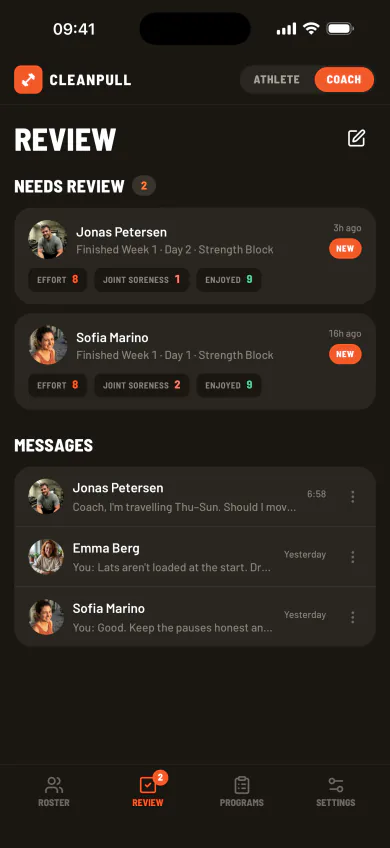
- Where does the logged work land? Look for a review queue that keeps completed workouts together, with the prescribed work attached.
- What does it cost as the roster grows? Per-athlete pricing changes the economics of taking on a beginner.
A reasonable middle path
Plenty of coaches keep a sheet for the thinking and use software for the delivery. Sketch the block structure where you can see all of it, then build it in the tool the athletes use.
This split works well when the sheet remains the easiest place to sketch a block and the software handles delivery, logging, and review.
And when to stay
A sheet remains a good fit for three people on the same program, or for a stable roster with little individual variation. Keep using it while the maintenance stays quick enough to make changes when they are needed.
Keep the sheet until its upkeep starts influencing the coaching decisions you make.
See also: percentage-based training.