Percentage-based training, from one max to a whole block
A practical guide to choosing a reference max, setting useful percentage bands, rounding bar weights, and running the method across a roster.
The short version
- Percentages turn one written block into a different prescription for every athlete, because each one calculates from their own max.
- Start with a recent, honest max. Every prescription in the block inherits its errors.
- Percentage bands are conventions with wide error bars, and they behave differently on the powerlifts than on the classic lifts.
- A roster adds hundreds of calculations, and maintaining them by hand is where spreadsheets start to fail.
How percentage-based training works
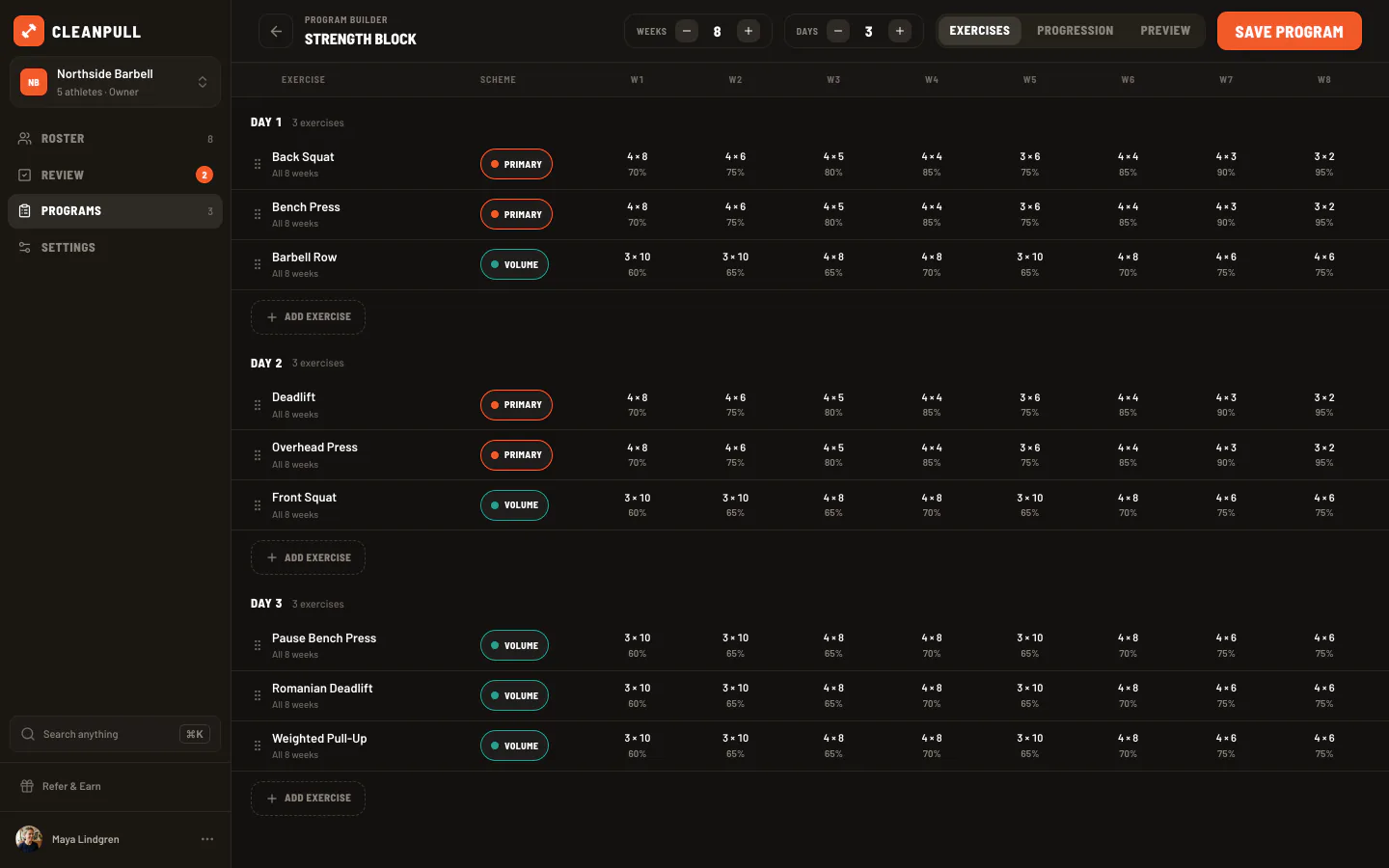
You establish a reference number, usually a one-rep max, then write the block in shares of it. Five sets of three at 80%. A top single at 92%. A back-off at 70%. The weight on the bar comes out of the athlete's own max, so the same written block produces different loads for different people.
A coach can therefore write one progression while ten athletes train at ten different weights. The numbers change with the athlete; the intended difficulty stays roughly consistent.
Choosing the max you program from
A poor reference max distorts every session that follows. Three problems come up often.
A max that is too old
An eight-month-old max may no longer match the athlete in front of you. A productive training spell makes every percentage too light; illness, injury, or time away can make the same prescriptions too heavy.
A max that never happened
Gym maxes tend to drift upward. A high squat, hitched deadlift, or bounced bench can still end up in the logbook as a max. Meet-standard lifts may run five to fifteen percent below those numbers, turning a planned 85% session into something closer to 92%.
A max nobody ever tested
When there is no recent single, estimate from a hard set of three to five completed with sound technique. That usually gives a reference close enough to start the block and adjust after week one.
Treat week one as a check on the number. If every prescribed weight feels wrong in the same direction, update the max and carry on. The athlete will usually notice the mismatch within the first few sessions.
Where the percentage bands come from
Ask five coaches for their bands and you will get five slightly different answers. Most fall near the ranges below. Treat them as working conventions with wide margins, not physiological cut-offs.
- 50–65% — warm-ups, technique work, speed. Cheap to recover from.
- 65–75% — volume that builds work capacity without much cost.
- 75–85% — where most productive strength work lives.
- 85–92% — heavy work, low reps, real fatigue.
- 92%+ — peaking and testing, used sparingly and usually late in a block.
The bands move with the athlete. Someone with a big engine and clean technique may hold 85% for sets of three while a training partner struggles at the same percentage. Training age, recovery, and the quality of the reference max all matter.
The Olympic lifts sit lower
Rep-max conventions came out of the powerlifts, where the set ends because the muscles quit. Snatches and cleans end for a different reason: the bar path degrades, the positions slip, and the lift misses while the athlete still has plenty left. A weightlifter's percentage work concentrates between 70% and 85% for that reason, and anything above 90% functions as a technical test.
This is also why long sets on the classic lifts tell you very little about a one-rep ceiling. A set of five snatches measures how well someone holds position when tired.
Using percentages and RPE together
Many programs use percentages for the plan and RPE for day-to-day adjustments. The two methods cover different blind spots.
Percentages give you a plan you can write in advance, audit, and repeat. They also ignore how the athlete slept, which means a bad day gets the same prescription as a good one.
RPE adapts to the day and depends on the athlete's ability to judge effort, which is a skill that takes years and degrades under fatigue. Novices routinely call an RPE 7 what a coach would score a 9.
A common setup is a percentage skeleton with an RPE cap: work up to a prescribed 88% single, but stop if it exceeds RPE 9. The coach keeps an auditable plan and the athlete has a limit for bad days. More on combining the two.
Rounding to loadable weights
Percentages produce numbers like 113.44 kg, and no gym stocks a 0.44 kg plate. Set a rounding rule in the program so every athlete handles those numbers the same way.
The bar's smallest increment is twice the smallest plate because plates load in pairs. Standard 1.25 kg change plates move the bar in 2.5 kg steps. Reaching 1 kg steps requires 0.5 kg plates.
For ordinary working sets, round down to the nearest loadable weight. A small reduction rarely changes the session, while rounding a heavy prescription up can turn a planned single into a miss.
Running one progression across a roster
One athlete needs a calculator and a notebook. A roster turns the same method into a bookkeeping job.
Say you coach twelve lifters on the same eight-week block, four main lifts each. That is 48 maxes underneath the block. Every week has its own percentages, so each week you are producing a few hundred numbers. When one athlete tests a new squat max in week three, their remaining squat prescriptions all change, and nobody else's do.
Spreadsheets handle the arithmetic well until the copies and edits multiply. A formula gets pasted one row short, a max changes in one tab but not another, and an athlete ends up training an outdated block.
Common failure modes
Treating the percentage as the goal
The number on the bar is a proxy for an intended effort. When an athlete grinds through a prescribed 85% because the sheet says 85%, on a day when 85% is behaving like 93%, the sheet has stopped serving them.
Never re-testing
A block built on a max from two blocks ago gets progressively easier as the athlete improves. Re-test, or re-estimate from a heavy set, at least every couple of blocks.
Using one max for related lifts
Front squat percentages derived from a back squat max will miss by a different amount for every athlete. Establish a reference for each lift you program by percentage, even if some of them are estimates.
Ignoring the athlete in front of you
Use the planned percentage as a starting point, then adjust from what the athlete does in training.
Where to go next
- Eight-week training block template — a complete progression you can adapt.
- Writing a percentage-based training block — the week-by-week structure.
- Programming for a whole roster — handling shared progressions, groups, and individual changes.
- Percentages and RPE together — combining the two without losing the plan.
- From spreadsheet to software — when the sheet stops being worth maintaining.
- Strength standards — where a lift places among competitive lifters.