Programming for a whole roster
A twelve-athlete roster comes with a substantial bookkeeping load. This guide covers shared progressions, sensible groups, individual adjustments, and weekly review.
The short version
- Adding athletes multiplies the reference maxes, working weights, program changes, and sessions to review.
- Write one progression and let each athlete's maxes produce their working weights.
- Copied templates and a single shared progression look identical in week one and diverge badly by week three.
- Build groups around training needs; percentages already account for differences in strength.
The arithmetic problem
Twelve athletes, four main lifts, eight weeks. That is 48 reference maxes and, at three or four prescribed sets per lift per week, somewhere north of a thousand individual weights across the block.
The calculations are simple, but there are enough of them to invite mistakes. A formula lands one row short, a max changes in one tab but not another, and an athlete trains the wrong weights for two weeks before anyone notices.
Copied templates versus a shared progression
Both approaches look tidy when the block starts. The difference appears as soon as something changes.
A copied template is one plan duplicated per athlete. Twelve copies, twelve places to edit. Change the week-five prescription and you change it twelve times, or you change it once and eleven athletes train the old version.
A shared progression is one plan that every athlete reads through their own numbers. Change week five once and all twelve see it. Change one athlete's max and only their weights move.
By week three, one athlete has tested a new max and another has had their volume trimmed. A shared progression absorbs both changes; copied plans have already begun to drift apart.
Build groups around training needs
Sorting athletes by strength is tempting, but percentages already account for ability. At 80%, a 60 kg lift and a 200 kg lift represent the same share of each athlete's capacity.
The reason someone is training matters more when you set groups. A first-year lifter who needs technical volume, a masters athlete managing a cranky shoulder, and someone peaking in five weeks need different blocks.
Most rosters settle into two or three groups, each with its own progression and a few individual adjustments. Ten separate blocks create ten times as much maintenance.
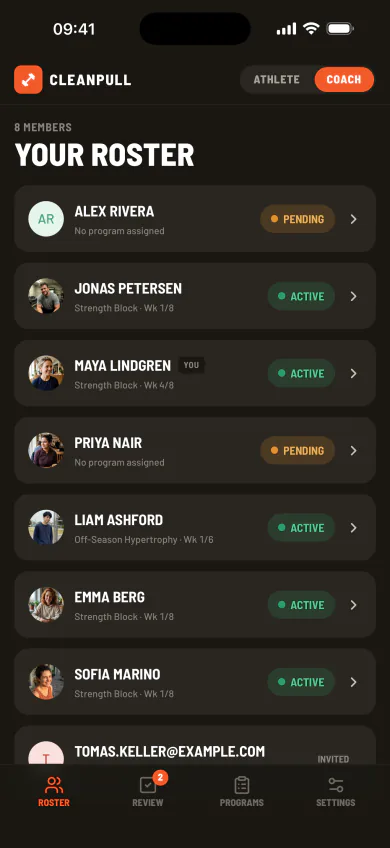
Individual variations without a new block
Athletes need exceptions. Someone cannot low-bar squat this month, someone gets extra pulling volume, someone travels every third week. Handle those changes inside the existing progression whenever the structure still fits.
- Substitute the exercise, keep the structure. Front squats can follow the prescribed pattern using the athlete's front squat max.
- Scale volume, hold intensity. An athlete short on recovery can run the same percentages for fewer sets and stay on the same progression.
- Let the max carry the adjustment. A deliberately conservative reference number lowers the working weights for a lifter returning from a layoff.
When the replacement is less obvious, use the exercise substitution framework to preserve the original training intent.
What you need to see each week
Once the block is running, much of the coaching time goes into checking what happened and deciding whether next week needs to change.
For each athlete you want to know: did they train, did they hit the prescribed work, how did the top sets look, and has anything changed that should alter next week. Chasing that across messages, videos sent at midnight, and a spreadsheet nobody updated is the part that does not scale.
A single queue of finished workouts keeps that review manageable. Each item should include the prescribed work, completed loads and reps, and any clips or notes from the athlete.
A consistent session review checklist helps the coach triage routine work without overlooking meaningful deviations.
When the roster grows past the tooling
There is a threshold, and many coaches hit it somewhere between six and fifteen athletes depending on how varied the roster is. Below it, a well-built spreadsheet can work well. Above it, the maintenance cost climbs faster than the roster because every athlete adds more places for changes to propagate.
Consider switching when routine changes take long enough that you start postponing them. The spreadsheet guide covers that threshold in detail.
See also: how to scale strength coaching, percentage-based training, and writing a block.