Percentage-based programming software
Write the block as percentages. Each athlete trains off their own target maxes, every prescription rounds to a loadable weight, and a new target max updates only that athlete.
The problem this solves
Percentage-based programming is straightforward for one athlete and turns into an arithmetic job for a roster. Twelve lifters on four main lifts across eight weeks is 48 target maxes and well over a thousand individual prescribed weights.
The arithmetic is simple, but the volume creates mistakes: a formula pasted one row short, a target max updated in one tab but not another, or an athlete training outdated weights for two weeks.
Cleanpull keeps one progression for the group and a target max for each athlete, then does the multiplication for you.
How it works
Draw the progression once
Lay out sets, reps, and intensity across the block. Everyone assigned to the program follows the same maintained progression.
Need a starting structure? The eight-week percentage-based block template includes the full progression and adjustment guidance.
Each athlete reads it through their own numbers
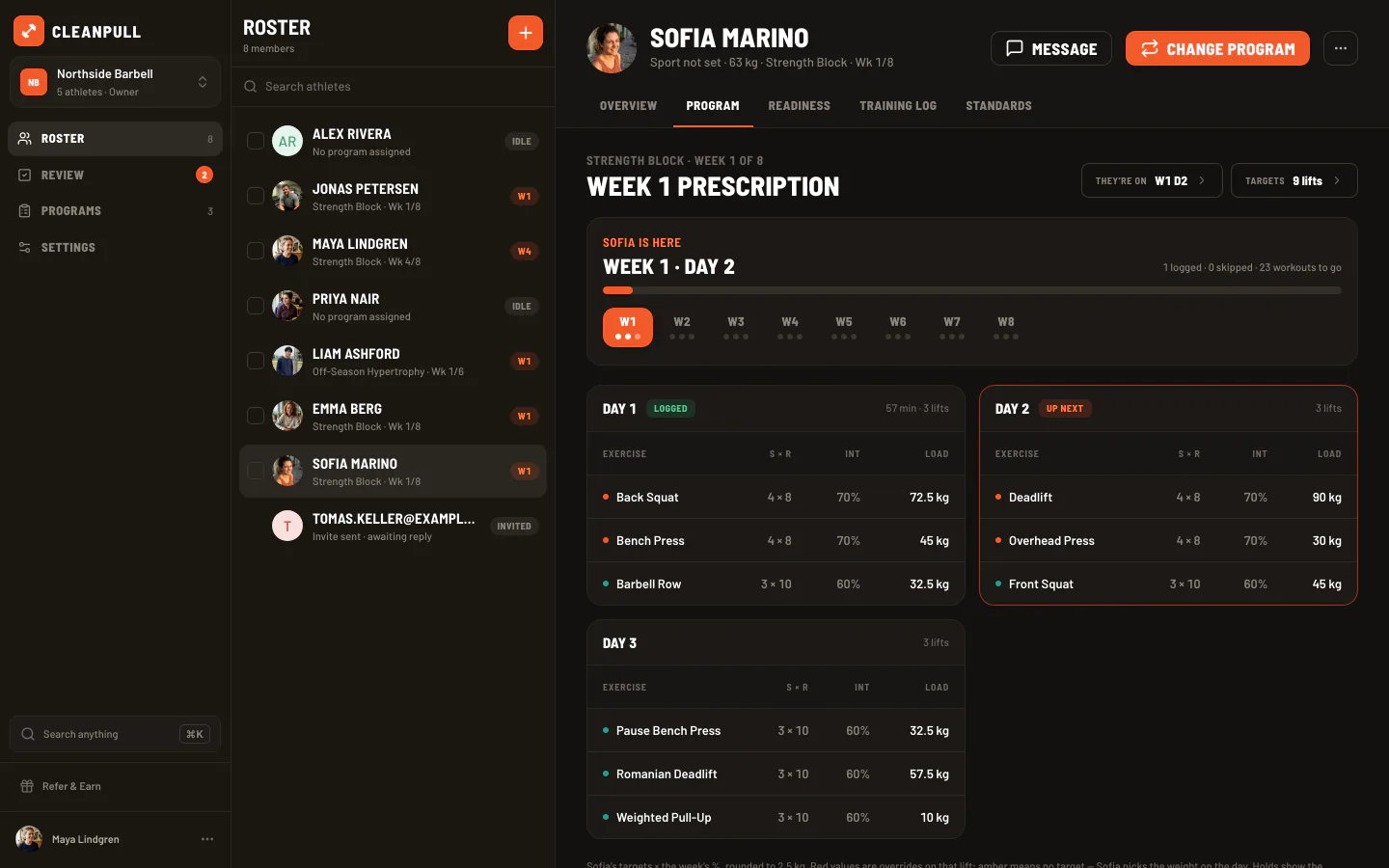
An athlete's working weight is their target max times the prescribed percentage. Ten athletes on the same program train at ten different weights that mean roughly the same thing to each of them.
Copied templates begin to drift as soon as a plan changes. A shared progression lets you edit week five once for everyone assigned to it. More on the distinction.
Loads round to what the bar can make
Percentages produce numbers like 113.44 kg. Set the bar's increment from the smallest plate pair available, then round each prescription to a load the athlete can make. Rounding down by default avoids turning a heavy target into an accidental max attempt.
A changed target max updates only that athlete
When someone tests higher in week three, their remaining workouts recalculate. The rest of the roster stays on its existing numbers.
Finished workouts arrive in one queue
Completed work lands in a review queue with the lifts, reps, loads, and effort targets attached. The coach can work through the week without reconstructing it from messages and notebooks.
Which lifts
The powerlifts and their variations, the Olympic lifts and theirs, and the accessory work around them. Each lift carries its own target max, because front squat percentages derived from a back squat max are wrong by an amount that varies per athlete.
Percentage conventions differ between the two families. Powerlifting blocks live comfortably at 80–90% for weeks; weightlifting volume concentrates lower, between 70% and 85%, because the classic lifts fail technically before they fail muscularly. The full guide covers this.
What it does not do
- No nutrition, habit, or lifestyle coaching.
- No client billing, invoicing, or scheduling.
- No marketplace for selling programs.
- No leaderboards or institutional reporting.
- No AI program generation. You write the program.
Pricing
Plans are per workspace, and the owner does not consume a member slot.
- Free — the owner plus 3 other members. $0.
- Pro — up to 30 other members. $15/month or $150/year.
- Studio — up to 500 other members. $100/month or $999/year.
Coaches and athletes both count toward the limit, and a pending invitation holds a slot until accepted or revoked. Each workspace you own carries its own plan. Athletes never pay for a roster spot.
Coming from a spreadsheet
Keep the spreadsheet while it still lets you make changes promptly. When routine edits start taking forty minutes and getting postponed, software may save enough maintenance to justify the move. More on that threshold.
Common questions
Can I mix percentages with RPE?
Yes. Write the block in percentages and cap the heavy sets by effort. That gives the coach a plan to audit and the athlete a limit for bad days. More on combining the two.
What if an athlete has no tested max?
Estimate one from a hard set of three to five completed with sound technique. That is usually close enough to start a program and correct after week one.
Does one progression have to suit everyone?
No. Most rosters resolve into two or three groups, each on its own progression, with individual adjustments layered on top. Substituting an exercise or trimming volume does not require a new program.
Kilograms or pounds?
Both, set per user. A coach working in kilos can have athletes who see pounds.
Is there a free tier?
Yes, with no time limit: the owner plus three other members per workspace. Enough to run a small group and see whether the model suits you.