How to write a percentage-based training block
A practical eight-week example, from choosing the reference max to placing the deload and deciding how the block ends.
The short version
- Fix the reference max before you write anything else. Everything downstream inherits its errors.
- Progress intensity or volume in a given week, rarely both.
- Place the deload where fatigue accumulates. Week four or five is common, but the athlete decides the timing.
- Write the block so that a changed max updates every remaining week automatically, or you will maintain it by hand.
Step one: settle the reference max
Pick the number the whole block calculates from. A tested single from the last few weeks is ideal. Otherwise, estimate from a hard set of three to five and use week one to check it.
Be conservative when you are unsure. A block built on a max five percent low still produces good training; a block built five percent high produces missed reps from week three onward, and the athlete loses confidence in the plan before you get a chance to fix it.
If “max” could mean several different numbers in your system, settle that first with the guide to training maxes, tested 1RMs, and estimated maxes.
Step two: decide what the block is for
Give the block one primary job:
- Accumulation. Build work capacity. Volume is high, intensity sits in the 70–80% range, and nothing feels heavy until week four.
- Intensification. Convert that capacity into strength. Volume drops, intensity climbs to the mid-80s and beyond.
- Peaking. Express it. Very low volume, high intensity, and the goal is freshness on a specific day.
An eight-week block for a general strength athlete usually runs four weeks of accumulation, three of intensification, and a taper into a test. A weightlifter's version compresses all of it and keeps the classic lifts in a narrower percentage band throughout.
That is one possible shape rather than a rule. Compare it with six other strength training progression models before choosing the pattern for your athlete.
Step three: write the weekly progression
Start with a simple progression. Hold sets and reps constant for a few weeks, add intensity gradually, and cut volume as the weights get heavier.
An eight-week squat example
- Week 1 — 5 × 5 at 70%
- Week 2 — 5 × 5 at 72.5%
- Week 3 — 5 × 5 at 75%
- Week 4 — 3 × 5 at 70% (deload)
- Week 5 — 5 × 3 at 82.5%
- Week 6 — 5 × 3 at 85%
- Week 7 — 3 × 2 at 90%
- Week 8 — work to a single at 95%, then test
The example is deliberately easy to read. The athlete can see where it is going, and the coach can trace a poor week back to the change that preceded it.
Change one variable at a time
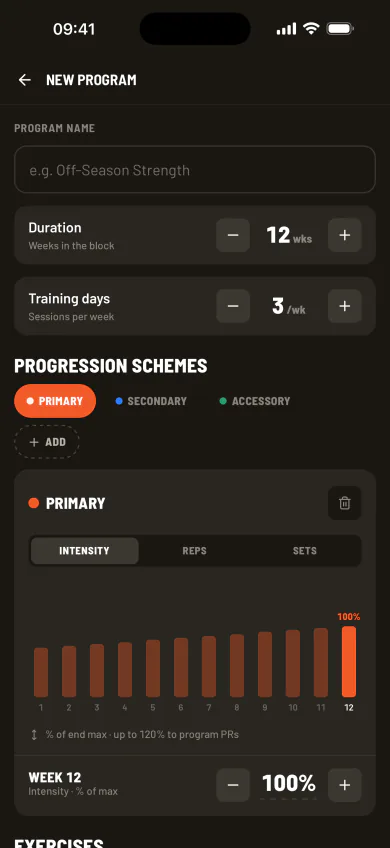
Adding sets and intensity in the same week makes the block harder to read. When week six goes badly you want to know whether it was the extra 2.5% or the extra set. Move one thing.
Step four: place the deload honestly
Week four is a common default for a deload, but the timing should follow the athlete. Watch for bar speed dropping at the same percentage, warm-ups feeling unusually heavy, disrupted sleep or appetite, and technique slipping on familiar lifts.
When you see those in week three, deload in week three. A deload taken a week early costs one session's worth of stimulus. A deload taken a week late costs the following three weeks.
Step five: decide how the block ends
Decide before week one whether the block ends with a test. A test week needs a different taper from an ordinary training week.
If you test, drop volume hard in the last week and keep a couple of light, fast sessions to stay sharp. If you do not test, finish at a heavy single you are confident in and use that to estimate the new reference max for the next block.
Step six: work out how it survives contact with reality
Blocks change. An athlete tests higher than expected in week two, or misses a week to travel, or shows up with a tweaked back. The question is what happens to the remaining weeks when that occurs.
A static list of weights has to be revised cell by cell. When the block is written in percentages and the athlete's max sits underneath it, one update can recalculate every remaining session.
That saves a few minutes with one athlete and hours across a roster. The roster guide covers the full workflow.
A checklist before you send it
- Does every prescribed weight round to something the bar can make?
- Is the reference max recent, honest, and specific to this lift?
- Does exactly one variable move per week?
- Is there a deload, and can you move it if fatigue arrives early?
- Do you know how the block ends before week one starts?
- If a max changes in week three, what has to happen to weeks four through eight?
Put the method into practice with the eight-week percentage-based training block template, or read more on the underlying method in the percentage-based training guide.